
So, the number of “like”s on Suzy’s post has gone up to 278,362 at the time of writing. Ryanair made 300 Euros thanks to their brilliant decision to charge €60 for every Boarding Pass she had not been able to print while on vacation. So, the real value of a Facebook Like is 0.00107 Euros. I hope this settles it once and for all. No more nonsense that every Facebook fan is worth 100 dollars or shit like that, please ;-)
Social
Social Media Marketing
Ryanair has sure done one hell of a job with Social Media Marketing!
In only 4 days, they got 269,597 Likes ;-)
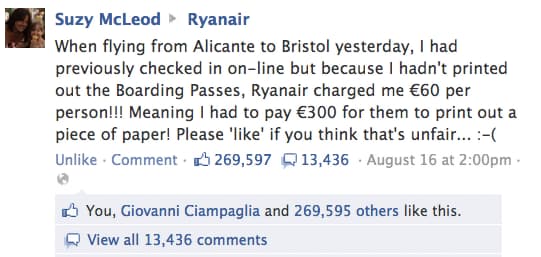
And I’m pretty sure all those 13 thousand plus comments were a success, too…
Your bank wants to be social
When you think you’ve seen it all, well, you haven’t. Apparently Banco do Brasil have changed their home banking interface to “make it more social”.
Manoel asks:
Minhas transações vão ser compartilhadas com meus amigos? Meus buddies vão saber quem são meus outros buddies também? Vai rolar troca de mensagem? “Oi fulano, não me pagou ainda porque? Acabei de ver que você recebeu a transferência do João.”
Loosely translated:
My transactions will be shared with my friends? My buddies will know who are my other buddies? You will be able to exchange messages? “Hi what’s-his-name, why haven’t you paid me? I happened to see that you have received the money transfer from John.”
What about pics of my dog? Or of your niece’s wedding? Or of the nice barbecue we had last week?
This is simply demented. Companies like Banco do Brasil apparently do not understand that they’re a service, not your friends. This is not the way you “put a human face” on the service you give customers. That would mean hiring nice people to do customer care, paying them a decent salary and empowering them – for real! – to go out of their way to help customers instead of considering “customer care” only a nuisance to be dealt with by outsourcing it to some sleazy company that counts the seconds an operator spends on a customer and tries to “optimise” this time in order to squeeze more money out of these people. This is a travesty. Read it all here. Em Português.
The same mistake again
Remember when the dotcom bubble burst in 2000/1, and the pundits who had raved over literally anything that had a “.com” in its name – hence, “dotcoms”, and who hadn’t said a thing when even a serious company like Sun started saying that they were “the dot in .com” or France Telecom started calling itself FranceTele.com – all of a sudden started saying that “this Internet thing” was overblown?
How pathetic. And they are making the same mistake again.
But what had happened? In short, the whole commercial web was based on the ridiculous idea that banner ads would be sold for a ton of money from portals to the so-called second generation of web services and onwards like that, for ever, to newer companies. It was nothing short of a Ponzi scheme, and of course it ended up in a mighty collapse, like these schemes always do.
But the pundits were wrong a second time. This “Internet thing” was NOT overblown. The Internet as a banner-based advertising medium had failed miserably, but not the web itself. People did non stop going online just because the party for greedy VCs and banks and IPO people had stopped. That was not the reason they had gone online in the first place, and they couldn’t care less.
Then came Google, which worked its way to finding the only hugely successful business model on the web, Adwords, basically the Yellow Pages of the web, and a few other products and services that were either making it thanks to Google (think Firefox, or WordPress) or on their own (think PayPal, Skype, or Dropbox). And a ton of new hoopla that this time was rebranded as “web2.0”.
How were these “web2.0” companies making – or, rather, not making – money? The same old way, selling poorly targeted advertising based on crappy sociodemographic user data, and leaving it to other companies to experiment on how to make ads suck less (performance marketing, behavioural marketing, retargeting etc). But this time is was “social media marketing”. Yeah!
While the darlings of “web2.0” crashed one by one, from Technorati to MySpace, from del.icio.us to Digg, Facebook was one of the very few success stories, and the only company that was able to grow not merely in size and raised capital (think Twitter) but also in revenue. Four billion dollars selling crappy ads doesn’t seem too bad at all to me for a newsreader and chat service.
But 4 billion in revenue and 1 billion in profits can hardly justify a crazy IPO valuation of 100 billion dollars, especially as the company has probably plateaued in terms of users, or at least in terms of users in the richer areas of the world. And so, it’s happening again. As the stock took a hit on the Nasdaq, the pundits are rushing to say that Facebook was just a fluke.
Yeah, right. A one billion people fluke. Facebook is strong. People use it and love it. Just like 10 years ago with the web, it’s not Facebook itself that has a problem, but rather the way in which it can make profits that can match the absolutely crazy valuation the company had on IPO day. Facebook is fine. “Social media marketing” – ads on social networks – is a failure.
What is “social media marketing” anyway? Banner ads on social networks? Oh, brilliant. Text ads close to nobody clicks on? And what about all the talk about “conversations”? Conversations with whom? Online, we like to talk to one another. Like it or not, nobody gives a fuck about what marketers have to say, and even less about what their “web PR” agencies say for them…