The same mistake again

Remember when the dotcom bubble burst in 2000/1, and the pundits who had raved over literally anything that had a “.com” in its name – hence, “dotcoms”, and who hadn’t said a thing when even a serious company like Sun started saying that they were “the dot in .com” or France Telecom started calling itself FranceTele.com – all of a sudden started saying that “this Internet thing” was overblown?

How pathetic. And they are making the same mistake again.

But what had happened? In short, the whole commercial web was based on the ridiculous idea that banner ads would be sold for a ton of money from portals to the so-called second generation of web services and onwards like that, for ever, to newer companies. It was nothing short of a Ponzi scheme, and of course it ended up in a mighty collapse, like these schemes always do.

But the pundits were wrong a second time. This “Internet thing” was NOT overblown. The Internet as a banner-based advertising medium had failed miserably, but not the web itself. People did non stop going online just because the party for greedy VCs and banks and IPO people had stopped. That was not the reason they had gone online in the first place, and they couldn’t care less.

Then came Google, which worked its way to finding the only hugely successful business model on the web, Adwords, basically the Yellow Pages of the web, and a few other products and services that were either making it thanks to Google (think Firefox, or WordPress) or on their own (think PayPal, Skype, or Dropbox). And a ton of new hoopla that this time was rebranded as “web2.0”.

How were these “web2.0” companies making – or, rather, not making – money? The same old way, selling poorly targeted advertising based on crappy sociodemographic user data, and leaving it to other companies to experiment on how to make ads suck less (performance marketing, behavioural marketing, retargeting etc). But this time is was “social media marketing”. Yeah!

While the darlings of “web2.0” crashed one by one, from Technorati to MySpace, from del.icio.us to Digg, Facebook was one of the very few success stories, and the only company that was able to grow not merely in size and raised capital (think Twitter) but also in revenue. Four billion dollars selling crappy ads doesn’t seem too bad at all to me for a newsreader and chat service.

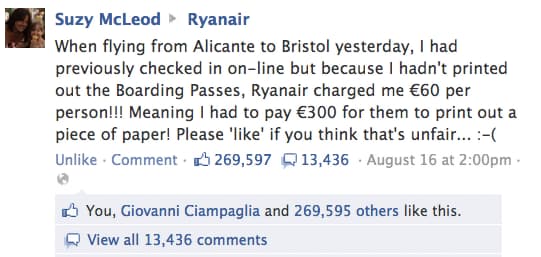
But 4 billion in revenue and 1 billion in profits can hardly justify a crazy IPO valuation of 100 billion dollars, especially as the company has probably plateaued in terms of users, or at least in terms of users in the richer areas of the world. And so, it’s happening again. As the stock took a hit on the Nasdaq, the pundits are rushing to say that Facebook was just a fluke.

Yeah, right. A one billion people fluke. Facebook is strong. People use it and love it. Just like 10 years ago with the web, it’s not Facebook itself that has a problem, but rather the way in which it can make profits that can match the absolutely crazy valuation the company had on IPO day. Facebook is fine. “Social media marketing” – ads on social networks – is a failure.

What is “social media marketing” anyway? Banner ads on social networks? Oh, brilliant. Text ads close to nobody clicks on? And what about all the talk about “conversations”? Conversations with whom? Online, we like to talk to one another. Like it or not, nobody gives a fuck about what marketers have to say, and even less about what their “web PR” agencies say for them…

FDR on Fascism

Unhappy events abroad have retaught us two simple truths about the liberty of a democratic people. The first truth is that the liberty of a democracy is not safe if the people tolerate the growth of private power to a point where it becomes stronger than their democratic State itself. That, in its essence, is fascism—ownership of government by an individual, by a group or by any other controlling private power.

Franklin Delano Roosevelt, 1938

The Future of Media Companies

What is the Future of Media Companies? What if there were no future for media companies? What if the Internet meant that, on the one hand, companies can go direct to their customers and don’t need them half as much as they used to, and, on the other, that the only “media” to speak of will be either algorithm-driven websites, like Google, or community-driven websites, like Facebook? Or a mix of the two. In any case, companies based on hard data and user-contributed information about what people search for and what they like, what they share, what makes them connect and to whom and why. What if it were totally over for top-down publishing venues, no matter how prestigious, and no matter how much low-cost user-generated content crap they add? Like it is! What if they knew it? My guess is that, rather than give up on their idea of being entitled to being the opinion makers and then trying to create the next Polyvore, they’d probably be launching their own branded products, just like Vogue is doing with Vogue Eyewear.

Evil Plans

I’ve had my fair share of crappy jobs, as we all have. You know what? I never hated a job because of what it took from me – all jobs take a lot from you, especially the best ones.
I hated a job because it never allowed me to give enough to the world.
That’s all I ever wanted: my best self, playing my best game.

– Hugh MacLeod, Evil Plans