Pop-up Ads and Banner Ads

About twenty years ago, pop-up ads were all the rage.

Banner ads had failed to deliver clicks. The very first banner ad, placed on HotWired, Wired’s first web magazine, had a staggering click-through rate of 44%.

Everybody was absolutely sure that they had found the right formula. For reasons nobody cared to explain, consumers apparently loved to interact with online ads.

That’s why they had gone online in the first place, wasn’t it? They bought new computers, clunky modems and paid an internet subscription to… see more ads.

It was off to the races. Just about everybody and your uncle crafted business plans centred around showing more banner ads to consumers, also called eyeballs.

As it turned out, the first AT&T banner ad on HotWired was a fluke. People had not changed, like they rarely do. They were clicking just out of mere curiosity.

Pop-up Ads

As curiosity died out, click-through rates plummeted. For a brief season, pop-up ads seemed to be the solution. Click rates were high and everybody got excited.

And why not? Those things were a thing of beauty, weren’t they? ;-)
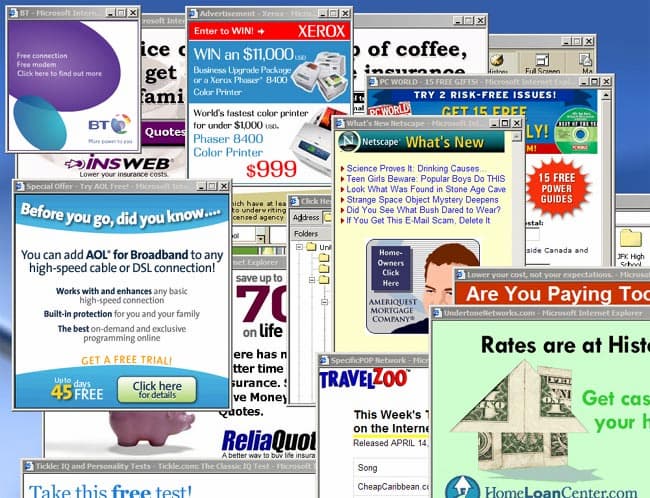
Once the eyeballs stopped clicking came new ideas, like pop-under ads, fake “close” boxes, or ads that moved around the screen and would not let your mouse close them…

Then came Google

Opera, a small niche browser from Norway, started adding tools to block pop-up ads. But Microsoft’s then dominant Internet Explorer browser would have none of it.

Google had just launched Adwords, their textual ads placed above search engine results. Pop-up ads were in the same market: ugly, no doubt, but they delivered clicks.

In a brilliant move, Google created Google Toolbar, an add-on to IE that blocked pop-up ads. This allowed them to kill off the competition coming from pop-up ads, play nice guy towards users who were sick of the constant interruptions, place their logo in front of millions of users and softly push them to use their search engine more often.

How is this relevant today?

Today, reputable news outlets are seeing marketing budgets move towards small websites that produce questionable content — most of it bullshit — because a set of ad-tech technologies known as programmatic advertising are allowing marketers to target users that read serious newspapers on those websites, at much cheaper prices.

It’s almost 2020, and it’s high time for newspapers to pull a trick like Google did.

[ to be continued… ]
Intent, context and identity

I found this interesting article by Don Marti about privacy and what would happen to marketing budgets the day users’ privacy were respected at long last.

I like how Don classifies ads in three groups: ads against search results, based on intent; contextual ads based on content, which can be thought of as similar to ads on magazines; and ads based on identity, on who the user is. These ads are bought wherever it is cheaper to buy them, and they are indeed very similar to direct mail spam.

All fine, except that there’s a missing variable: the format of the ads.

Ads on search engines are textual. They were presented as a form of direct marketing based on intent from the very start, as the yellow pages of the Internet, if you wish, and they perform very well for both those who sell them and those who buy them.

Banners

Banner ads, on the other hand, have been a mess for a quarter of a century.

They were never presented as the new form of magazines ads, and for good reason. The format is small and terrible, and it is very hard to use banner ads to get a message through. To make things worse, creativity has always been an afterthought at best.

Click rates were very high on the very first banner ads, starting with the one that appeared on Wired in 1994. This led to the very wrong idea that Internet users were so interested in companies and their offers that they would want to interact with these ads.

Hence, the IAB.

No, not the Internet Advertising Bureau, but the Interactive Advertising Bureau.

Too bad that today that interaction can be measured in little more than a click every thousand impressions, or about 1/50th of what the click rate for search engine ads is.

Ad-tech

Banner ads are the biggest failure of the Internet, ever. This is why ad-tech companies have been able to sneak in and track our every move to try to sell a terrible format.

Privacy-enabling tools are a great step forward to limit the data collection abuse and the flight of marketing budgets from legitimate websites to nobody knows where.

But I doubt we will be able to win this battle unless we undo the mistake that opened the way for ad-tech companies. The banner ad format is a failure and it must go.

Targeting and Food Labels

Now, what in the world do targeting and food labels have in common?

They both lie.

Have you ever met someone who managed to get healthy thanks to food labels?

The kind of people who count their calories and take notes about what they eat.

Often the same people who eat fatless cheese and drink diet soda.

Neither have I.

Somehow, it doesn’t work for them. It doesn’t work for anybody.

Because, very simply, that’s not the way it works.

It’s either simpler than that, or a lot more complicated.

So complicated, in fact, that the only way to crack it is to keep it simple.

Instead of counting calories, just stop eating fried, salty or sugary processed shit.

And drink nothing but water.

Then it’s likely that not getting some exercise will feel worse than working out.

Not the other way around.

No matter what Michelle Obama or the Coca-Cola Company tell you, if you eat — and drink — garbage food, there’s simply no way you can burn off all that shit by working out.

You’re welcome.

A cover-up

The labels are merely a cover-up.

You know what you’re eating, so if you over eat, it’s your fault.

No, it’s not.

The labels give you information, but not the information that matters.

Why should an average Joe be able to read them and make a sound choice?

Those who are to blame are those who produce, market and push garbage food.

And those in government who allow this scam to go on.

Say, have you ever seen a food label on an apple?

Have you ever met someone who got obese by over-eating salad?

Fine, Doctor

Fine, Doctor, but what the hell does this have to do with advertising?

Say you need to sell the worst advertising format ever, the banner ad.

And people in charge of buying this shit don’t have a fucking clue.

It’s a marriage made in heaven, isn’t it?

You misdirect their attention towards what doesn’t matter and you win.

Hey, look at the food label!

No fat in there.

What could go wrong if I ate a whole bag of cookies?

The more ignorant or desperate people are, the easier it is to screw them.

And few people in the world are as clueless as the average marketing manager.

The format sucks? Nobody ever pays any attention?

One person in five is trying to block these ads altogether?

There’s not one single banner ad that was a smash in 25 years?

Worry not.

Look at the food label.

I mean, at how precisely (or not) we can target consumers for you.

And you’re fucked.

The Internet Is for Upstarts

As said, The Internet Is For Porn and Direct Marketing.

And for upstarts.

Internet advertising has been around for a quarter of a century and it has created no discernible brands in any category, as Bob Hoffman rightly pointed out.

That’s hardly surprising. The banner ad is the worst advertising format ever.

Those who like to blame Ad Tech for everything say that, if only banner ads were not targeted, they would carry a signal, and could contribute to the emergence of brands.

Not so.

The format sucks. You can’t tell a story. It’s the same format on The New York Times and on your cousin’s website. Internet users are flooded with way too many banner ads.

There are more problems that need to be solved than some would like to think.

Away

On the other hand, to say that the Internet has created no brands is not true.

Away, Glossier and Warby Parker are huge hits.

I’m sure there a quite a few more mid-level brands that made it.

This is what the Internet is for, apart from porn and direct marketing.

It’s a shitty, distributed, low-cost Kickstarter to help small companies emerge.

Then, if they ever make it, they will start doing real advertising.

Offline

Real advertising means offline.

Like the Big FANG. Facebook, Amazon, Netflix and Google.

Do the big brand you work for a favour: act like a grown-up.

Like the Big FANG, not like some small company operating in a basement.

Do real advertising, not the tricks the small guys do to get noticed.

Don’t make your brand look dumb just because you want to look cool.

I know, I know…

I know, we were all hoping for better things for this child of ours, the Internet.

Some hoped it would spread knowledge. Not fake news.

Somebody else said it was “unconceivable that we should allow so great a possibility for service… to be drowned in advertising chatter”. No, that was not Tim Berners-Lee.*

But porn, direct marketing and helping upstarts get a breakthrough is not too bad.

* It was Herbert Hoover, then US Secretary of Commerce, speaking about radio, in 1922.